“Decisions” – Dissecting the Subconscious

If there is one thing that’s common to all business leaders, it’s the need to take decisions every single day of their life. Decisions that can change the direction of their company, that can impact the lives of people they lead and that can turn risks into immense rewards and a legal catastrophe with equal ease. The process becomes so ingrained that we don’t usually give it a second thought. But over the new year, I sat down and introspected on how exactly I make my business decisions, what were the drivers behind the successful ones and what did I learn from those that didn’t pan out as intended, and ultimately if there were any patterns that I could see in my decision-making behaviour.

The theory of Head, Hearts and Guts

One of my mentors told me few years back that experienced leaders use a balance of head, heart and guts while making their decisions. The more I delved into this, the more fascinated I became. Depending on the topic and context at hand, we may have used varying proportions of each of these ingredients in our decision-making, but a seamless blend of these has truly been a guiding light whenever I have stood at complex crossroads. It looks quite simple – use numbers, data, facts and logic while assessing your options, and most of us have been hard-wired to use this as the default tool. It’s also the most tangible to explain to others. But over the years, I began appreciating the beauty and relevance of the other two as well. The heart brings in empathy, and especially when dealing with people-related decisions. Empathy is fast-becoming a much desired leadership trait in these times of volatility. And then comes the gut – ultimately your instinct can trump your head and heart, especially when the comparison of your options leaves you even more confused than before!
The Power of Questions

One commonality I have realized in every decision-making meeting of mine is my constant drive to ask questions to my team. In many of these discussions, I may not be the most technically qualified person in the room. But as I ask more and more questions to my team, the analysis of what initially seemed a complex topic starts becoming clearer. Its akin to peeling an onion, layer by layer. And more often than not, if you keep asking the right questions, the mist around the ambiguity of the problem starts lifting and the viable options start emerging as if by magic, like a ray of sunshine peeping through dense fog.

Explaining the Whys

My experiences have also taught me that as a leader, its not just enough for you to take the decisions – its equally critical to explain the whys of those decisions to your team. This started dawning on me when I used to conduct townhalls for our entire country staff. I would often find myself going down the path of explaining many of the business, policy and people decisions that we would make as the leadership team, and that would leave me more confident and energetic at the end. When leading smaller team meetings on any business issue, I put all aspects of the problem on the table based on inputs from everyone. And then I would find myself thinking out aloud with my team on the analysis of our options, and ultimately end up discussing the rationale of whatever decisions we would take very openly with the team. I think when you do that, you make the team an integral part of the decision-making process, giving them clarity, confidence and comfort. Not everyone may agree with the logic, or the decision, but at least everyone knows why we did whatever we did. This can be a draining process and needs lots of energy every single time, but I think its as important as the actual decision that you make.

Making Peace

No discussion on decision-making is complete without bringing in the aspect of accountability. As leaders, we are ultimately accountable for the decisions we make. For me that’s stating the obvious. But what I learnt over the years beyond just taking accountability is how to make peace with your decisions. And as I got better at that, I found myself calmer in my mind and more confident in my head. As long as you know you took your decision based on all the inputs you could gather and by using the right blend of left and right brains – after that, the consequences are not in your control. There are so many externalities that come into play in the final outcome that fretting over things not in your hand will only add to your anxieties. And hence, I now use every decision as a learning opportunity as against a test of my leadership abilities, and that gives me peace to stay focused, take things in their stride and prioritize future over past. The ‘what-if’ gets replaced by ‘what’s next’!

While there is so much research on the art of decision making, I found one of the most impactful teachers to be the ability to introspect and learn from the real-life examples that we live through every single day.

All you need is an open mind!
No, I don’t want to forget 2020!

Pretty much everyone around the world wants 2020 to be wiped off from their memories, and rightly so. In our modern history, this was the first crisis this world faced since the World-Wars that touched the lives of every citizen of this planet. Yes, the extent of impact varied significantly – the rich-poor chasm only grew wider; many lost their loved ones while others were spared that pain; and surprisingly many developing nations responded far better than their more developed counterparts. But nevertheless, everyone will carry experiences that will be passed down to the future generations as ‘once-in-a-lifetime’. And that’s the reason why I want 2020 to be forever etched in my memory, for it provided lifelong lessons so rich, humbling and inspiring that whenever the chips are down in the future, all you would need to do is look back at this year and gain strength and confidence from these learnings.

  1. Resilience: When the lockdown hit us unawares, business operations could not just come to a standstill. We had properties to be managed, customers to be taken care of and the organization to be fortified. And all of that while ensuring the safety of everyone around us. It was like trying to fix punctured tyres while the car had to keep moving. And this was not just our business – I hear the same sentiments across the board from my friends and peers across industries. So collectively, the entire corporate world threw counter-attacking punches and the steely resolve saw us overcome the shock with confidence. Crisis tests strength of character, and there was abundance of that in display. “Never under-estimate the human spirit of grit and gumption!
  2. Adaptability: If there is one thing that we all found out about our own selves during this year, it surely will have to be our ability to adapt when crisis hits home. Getting so many things done remotely which we probably never thought was possible, beginning to unleash the real power of digital for our organisations by breaking long-believed myths, transforming consumer habits that took years to change in a matter of months – in fact, the list was a stark reminder of theory of evolution and how man has evolved over generations through adapting to the changing environment. “We often underrate our ability to adapt, even when it’s the very reason we exist today!
  3. Balance: This is one of my favourites, equally applicable to our professional and personal lives. And this year just showed us how much valuable this was in enabling us to not just defend against the crisis, but also aggressively counter attack where needed. Most had to strictly control or curtail costs, and yet invest intelligently  with an eye on the long run; meeting the interests and needs of all stakeholders from customers to suppliers to shareholders to staff, even when they may be at odds, and without compromising the happiness of the family; leading with a cool head, warm heart and strong guts – every single day, each one of us was a magician juggling multiple balls in the air while riding a cycle on a rope string high…and we did it with a smile! “Crisis can galvanize us into building better balance in the way we approach life!
  4. Compassion: When the pandemic started, it was said that everyone is suffering and no one is spared, from prime ministers to world champions to corporate honchos. But very soon, the sad reality became self-evident that it was the under-privileged across the globe that suffered much more than the others, and we Indians only had to look outside our homes to see the plight of those less fortunate than us. And so, while the papers chose to cover mostly the horrors of the pandemic, there were also so many stories of kindness, of giving and of sharing that warmed our hearts and restored our faith in humanity. Compassion was amply in the forefront by how organisations, including ours, came out in force to selflessly support communities around them and how individuals took up the mantle to feed hungry mouths and give their time, money and resources to lift spirits all around. “We all got reminded that compassion is a thread that binds humanity together!
  5. Gratitude: End of the day, this is probably the most appropriate word that summarizes my learning and experience from the year. The feeling of thankfulness and the realization of being more fortunate than many around us is what will always keep us humble and help us put things in perspective not just when the next crisis hits our lives, but also during every single moment where we are tempted to exclaim, ‘oh god, why me!’ “It often takes a crisis to remind us that gratitude is key to peace…and how unfortunate is that!

Among all these learnings, 2020 reinforced the fact that man is a social animal – we thrive in a community, we relish relationships, we crave for that human connection and our wanderlust to explore the world makes us unique. And I am thus quite sure that whatever ‘new normal’ Covid may have brought in, it will surely not dent any of these fundamental human traits that make us who we are!

So yes, I do eagerly look forward to 2021, but not at the expense of trying to forget 2020 – for it taught me to try to be a better-balanced leader, a more patient father, a more compassionate citizen and a humbler human. And for that I remain forever grateful to 2020, the year like no other so far.

Keep the faith!

‘Factfulness’: A refreshing read to open our minds

We live in a world where infinite information is available at the swipe of a finger, and where obdurate opinions turn friends into foes on social media platforms. Our opinions consume us and make us arrogant, because we feel empowered by that information treasure trove on our devices. But when those opinions are not backed up by facts, that’s where the world starts appearing far more caustic than it actually is.

I am ever so grateful to a colleague of mine who recently recommended a book to me that I now strongly feel should be read by every human being, irrespective of their location, vocation or interests. I have never written a book review before, and neither have I ever recommended any reading that is applicable to such a wide spectrum of audience, but after devouring “Factfulness: Ten Reasons We’re Wrong About The World – And Why Things are Better Thank You Think”, I couldn’t help but dedicate this blog to the most impressive and yet simple insights about the world I have read in a long time. Highly recommended by Bill Gates and Barack Obama among others, this book is even more relevant for everyone in times of this pandemic as it so eloquently provides a fact-based view of our world as against the heavily biased and media-influenced opinions that we are bombarded with every day. Starting with a quiz, replete with insightful charts/graphs and humorous anecdotes, and breaking down health and economics through such simple, innovative and vivid illustrations, the book is a fast-paced read, funny and serious at the same time.

If you were asked very simple questions about global trends – on population, poverty, education, healthcare, environment – you would think that you would ace them with ease. But when authors Hans Rosling, Professor of International Health and a global TED phenomenon, along with Ola and Anna Rosling started posing these questions to eminent audience from all walks of life – doctors, teachers, lecturers, scientists, investment bankers, CEOs, journalists, activists, politicians and even Nobel laureates – basically highly educated people, stunningly most of them got most of the answers wrong! In fact, so wrong, that a chimpanzee picking the answers at random would have done better than them. Shocking, right? How can some of the most intelligent people on this planet display such ignorance about the world? How can most people in the world be so wrong about their own world? Han’s findings told him that it was not because of lack of knowledge or up-to-date information, but due to the overdramatic worldview that is constantly fed to us that satiates our brain’s natural thirst for drama and extremes. This blocks our ability to look at the world in fact-based manner, backed up by real data. This fact-based view is not exciting, not dramatic, doesn’t tantalize our senses, and may even be boring to discuss with anyone. But it’s the truth – it’s the mundane truth that the world today is a far better place to live in than even before, on any criteria that you may want to measure it on. But this change happens slowly, and gets drowned under the din of screaming new channels that make us believe that the world couldn’t have been worse. It is this perception of drama that blocks our rational senses and prevents us from using facts and data to evaluate happenings around us. Specifically, Hans talks about 10 dramatic instincts that cloud our ability to think rationally and logically, and these instincts are as relevant in understanding the world around us, as they are for any other aspect of our lives – our professions, our family and our attitude in general.

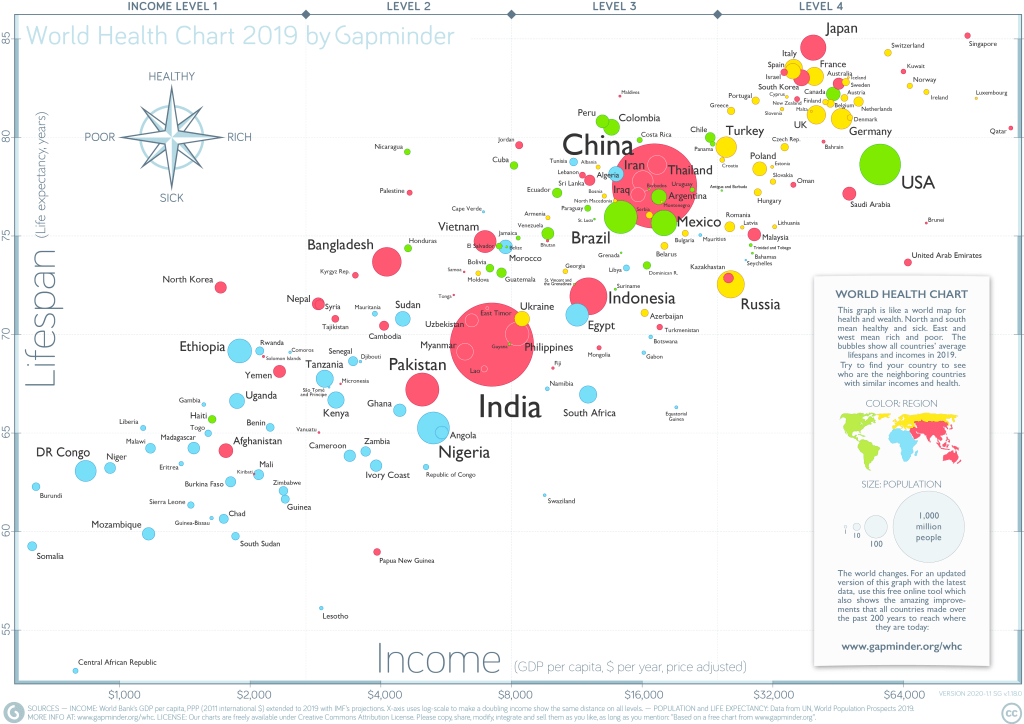
Source: Gapminder.org
  1. Gap Instinct: This refers to our temptation to divide all things into two distinct and often conflicting groups, with an imagined gap in between. (e.g rich and poor countries). The reality in life is not in extremes, and the majority are right in the middle of that gap. Comparison of averages and comparison of extremes in two sets of data can both be equally damaging. As a foundation of the book, Hans divides the world in 4 income levels, each level characterized by drinking water, means of transportation, way of cooking, type of food and facilities of sleeping. I found this way of thinking a much more realistic way of understanding the world, than blindly characterizing every country as either rich or poor.
  2. Negativity Instinct: This is about our tendency to notice the bad more than the good – ‘things are getting worse’, is the most often heard statement about the world which couldn’t have been farther from the truth. (from poverty to life expectancy to child mortality to battle deaths – the world is getting much better, contrary to our negativity instinct). Media will bombard us with negative news as it’s dramatic, while positive changes are gradual and thus less exciting, which creates a negative impression of the world around us.
  3. Straight Line Instinct: This is the assumption that line graphs will always continue straight, but many global trends are rather curves, humps, S-bends etc. The shape of global population forecast curve is one such example.
  4. Fear Instinct: This instinct presents us an image of the world as dangerous as it could ever be, fueled by the media tapping into this instinct to grab our attention. Natural disasters, plane crashes, terrorism, wars – while these fears are not unrealistic, but it’s well-proven by facts that the world is a far safer and less violent place than it ever has been. (trivia: flying has gotten 2,100 times safer over the last 70 years; no. of deaths from natural disasters is just 25% of what it was 100 years ago!)
  5. Size Instinct: This is one of my personal favorites and I find it very relevant in the corporate world of number crunching and data analysis. People typically get things out of proportion, and misjudge the magnitude of things, and thus a lonely number seems far more impressive than it actually may be. Comparing numbers together, using the 80/20 rule and normalizing data on a per unit basis will give us a much more accurate sense of proportion and comparison of data.
  6. Generalization Instinct: This is another personal favorite because I see this all the time all around me, and even I am guilty of it many times. Our minds are tuned to categorize and generalize things to make sense of the world, often resulting in stereotyping. An example is how we generalize about countries/regions we have never travelled to. An American never been to India may generalize how Indians live based on his opinions influenced by media, without appreciating that a rich man in Mumbai may live in far greater luxury than a poor man in Manhattan. To avoid generalizing, we must look for differences within and across groups. We must also beware of ‘majority’ – something I see regularly at work. When someone mentions majority, it could mean 51% or 99%, and each could have very different implication on the matter at hand!
  7. Destiny Instinct: This is the idea that innate characteristics determine the destinies of people or countries, a belief that things have always been a certain way and will never change. I loved the example Hans used to make this point. It is commonly touted that people from religion X have much bigger families than others. If you divide the world into different religions, and for each religion, plot the population on a graph with X-axis being income level and Y-axis being babies per woman, you will clearly see that there is a clear reverse link between income and babies per woman – irrespective of religion! We must remember that big changes across cultures and countries happen very slowly, and no one is ‘destined’ to remain in a certain way forever.
  8. Single Perspective Instinct: Another one that is a lifeline especially for leaders in the corporate world. This instinct lets us believe all problems have a single cause or a single solution – it makes the world very simple in our mind, whereas in reality, the world is extremely complex and looking at issues from multiple perspective even if they are not within our domain of expertise is imperative if you want to get closer to the facts. Often it is our ideologies and our professions that instill a bias in us of being unable to look at things from various perspectives. The book shows a beautiful example of Cuba on the health-wealth bubble chart. Depending on how you interpret Cuba’s position on the chart vis-à-vis other countries, it can either be made out to be the healthiest of the poor countries, or poorest of the healthy countries – while in reality it is both. If you get stuck in the single perspective instinct, you will be led to a narrative that suits the narrator instead of your brain processing the facts in a rational manner. It is imperative to look at a problem from all angles to find more practical and holistic solutions – something every professional from any field must always keep in mind.
  9. Blame Instinct: As the name suggest, this is the instinct to always attribute a simple reason and blame on to someone when something bad happens. We often tend to look for the bad guys that confirm to our existing beliefs and opinions, and find solace in that – evil businessmen, lying reporters, corrupt politicians – it’s easy to pin blames as a cause of some of the most complex problems on earth. Real world is far more complex, and we must resist the urge to blame an individual or a group, as that gets us to stop thinking beyond the blame, and try to uncover the root causes of complex issues. As the book says, look for causes, not villains.
  10. Urgency Instinct: ‘It’s now or never! If you don’t act now, or change your thinking now you will regret it for the rest of your life!’ How many times have you heard these around you? That’s precisely what the Urgency Instinct is  – the call to action that makes you think less critically and decide more quickly even when almost always in reality, it’s never that urgent. When a decision feels urgent, always take a breath and be wary of drastic actions.

End of the day, there are three reasons why I found Factfulness one of the most enlightening and inspiring books I have read:

  • It provides us a fact-based worldview, which makes us aware of the biased pair of eyes with which we so often look at the world. And when we do that, we will realise that the world is not as bad as it seems to be – yes it has serious problems that we need to continue to work hard at, but it is also far better on almost all counts than it ever was in the past.
  • Irrespective of whether we are curious about the world around us or not, the book shows us the power of using facts and data on any issue we deal with in our life, and how devastating it can be when we carry opinions which are biased and not supporting by facts. At many levels, the book is about our attitude towards our lives, and how we can become more positive and less stressed when we embrace critical thinking over dramatic instincts.
  • Lastly, and probably most importantly, it makes us feel humble and curious to learn – two qualities that the world today so desperately needs!

Hans Rosling, together with Ana and Ola, decided to write this book in 2015 as a tribute to his lifelong work on creating a fact based worldview and dispelling ignorance. A year later he was diagnosed with cancer and in early 2017, he left for the heavenly abode. Ana and Ola continued his dream and lead his mission today through their efforts. Google about them and watch Han’s TED talks if you haven’t – they have influenced my thinking, and hope they do yours too!

Leadership in times of crisis

Just like how on-field pressure brings the best out of captains across various sports, it is in crisis that the true character of a leader is tested in the corporate world. I am no expert in leadership coaching, and there is enough out there online to satiate your thirst for that – but I thought of sharing how my experience has been so far in leading a business through a crisis as unprecedented as this. If this resonates with some of you, and if you want to add on more personal learnings to this, then I consider this a job well done!

So what have I learnt as a leader so far since Covid invaded our lives? 5 lessons in summary.

1. Taking decisions with imperfect data and unreliable forecasting

For all leaders, effective decision making is almost always contingent on robust data analysis and forecasting the future implications of their decision. But that was when we were living in normal times, which today we aren’t. Since WW2, the world has probably never transformed as much in such a short time as it has over the last few months. And that has meant that leaders no longer have the luxury of perfect data to base their business calls on – much data that is valid today becomes irrelevant tomorrow in times of such crisis, and past data patterns lose significance.  But decisions still need to be made, and many that couldn’t have been more critical to the company than ever before. So leaders have been adopting various tactics to overcome this handicap – trusting your instincts, relying on your trusted advisors, peeping at your competitors or always having a Plan B/C ready – whichever be the case, Covid provides a great opportunity to learn to thrive in ambiguity!

2. Balancing the paradoxes:

I have always believed that a versatile leader is the one who balances seemingly contradictory objectives so skillfully that they don’t appear incongruous at all. In times of such crisis, the need for leaders to balance such paradoxes couldn’t have been higher. How do I get growth back and cut costs and preserve cash at the same time? If I do everything my customers want, then my investors may not be happy! How can I keep fire-fighting every day, and still keep an eye on the future for opportunities? How do I keep a cool head, and yet have a strong heart? How do I keep people’s morale high, when I know I may need to take harsh decisions? The paradoxes can differ based on your context – but the ability to artfully navigate through them without swaying to extreme ends of the spectrum is a universal trait of strong leaders especially in times of such crisis!

3. Leading with Compassion, Courage and Calmness

A once in a generation crisis like this can unnerve even the best in the business – so it is only natural for your people to feel anxious, uncertain and scared. The need to engage them with compassion and care, by not only putting their physical health as the top priority, but also recognizing their mental anguish with empathy is paramount for leaders. Courage is an obvious one – pretty much every aspect of the business will need courageous decision making and the ability to steer the ship through this tempest will require great fortitude and endurance for the long haul. This is certainly not the time for the faint-hearted! Finally, a cool mind and a calm demeanor need to go hand in hand with having a strong heart. We are being bombarded by negative news every hour, and there is so much noise out there that it is dangerously easy to fall into a vicious spiral of doom. Great leaders are the ones who declutter their minds, strip to the basics and sieve the information overload to stay razor focused on what truly matters.

4. The power of “I don’t know”

Much is starting to being written about this in the media, and rightly so. Such a great equalizer Covid has been, that no leader or expert anywhere in the world can claim to know how things truly are presently, forget predicting how things will be in the future. Leaders who have not only the humility, but also the courage to acknowledge what they don’t know in front of their people are the ones whose authenticity comforts people. “I don’t know how badly our business will be crippled by Covid, but what I do know is that we are in this together and will fight with all our collective energy to protect what we have so assiduously built over the years” is way more powerful than pretending to assuage people through hollow predictions of a rosy future.

5. As always, it’s ultimately the attitude!

How chained are you by the past that you are unable to free up your mind to realize there is a very different future awaiting you? How flexible are you to think on your feet and ready to embrace whatever gets thrown your way? How tranquil is your spirit to appreciate that stressing over what is not in your control will only hurt you even more? Crisis often makes one wistful – great leaders are those who can channelize that self-reflection into energy so pervasive that it  galvanizes the organization into a battle-ready mode! Didn’t someone say that tough times don’t last, but tough people do?

My 10 commandments of productive meetings

Have you ever wondered how much time we spend attending meetings daily? I am pretty sure in an collaborative environment like ours, the number will be quite high. But have you also wondered how many of those times we felt that the meeting was a waste of our time? – Either because we had nothing to contribute, or because no decision was taken at the end, or because only the bosses kept talking all the time, or because the content of the meeting was poorly prepared or simply because the meeting either started late or ended late throwing your calendars haywire!

As we start becoming busier in the new year, I would urge you to think deeper and promise to yourself that you will do your best to make our meetings timely, sharper and efficient, whether you are a meeting organizer, leader or just a participant. Here are my guiding principles of conducting productive meetings in mind:

1. Only invite necessary and relevant people: Having people in the room only due to hierarchy or to keep in FYI is a waste of their time

2. Be disciplined on time: Block the right time duration based on the content – not too long, not too short. And then ensure that the meeting starts and finishes on time

3. Assign a meeting leader: This is the person who calls for the meeting and leads conducting the meeting

4. Have a clear objective/outcome defined and communicated at the beginning: It is imperative to know what you want to achieve from the meeting (just like a KPI),  so that it can be measured at the end if the meeting was successful or not. (Personally, this is the most important for me!)

5. Assign a note-taker: Someone needs to capture the key outputs from the meeting

6. Be well prepared: Prepare the content and presentation well; anticipate questions beforehand and be ready to deliberate

7. Send pre-read material (if any) well in advance: Sending material only sometime before the meeting is of no use

8. Speak up: Seat at the table = voice at the table. There is no point having a meeting being dictated only by a few

9. Do not be on your phones or laptops: There is nothing more disrespectful to everyone around than that. (if there is a work exigency, excuse yourself out of the room)

10. Ask for feedback: If you are truly focused on learning, ask for feedback from peers/managers on how you did in the meeting

Hope the above helps as we all build an organisation that’s highly efficient, agile, productive, driven by excellence and respectful of everyone around.

Break free from shackles of the past

On the new year eve, I shared the following story and message with my organization. The message may resonate with many of you as well!

A man was once passing a herd of elephants. He suddenly stopped, confused by the fact that these huge creatures were being held by only a small rope tied to their front leg – no chains, no cages. It was obvious that the elephants could, at any time, break away from their bonds but for some reason, they did not. He saw a trainer nearby and asked why these animals just stood there and made no attempt to get away. “Well,” the trainer said, “when they are very young and much smaller we use the same size rope to tie them and, at that age, it’s enough to hold them. As they grow up, they are conditioned to believe they cannot break away. They believe the rope can still hold them, so they never try to break free.” The man was amazed. These animals could at any time break free from their bonds but because they believed they couldn’t, they were stuck right where they were.

Like the elephants, how many of us go through life – professional or personal – hanging onto a belief that we cannot do something, simply because we failed at it once before? How many of us truly believe that the shackles of the past have no bearing on the wonderful accomplishments we can achieve in our future? And how many of us keep holding onto the past too constrained by it, too afraid to break free from the metaphorical rope and surprise ourselves with the amazing potential each one of us has to innovate, excel and be far better than we ever had been before?

There couldn’t be a better time than the end of a decade to reflect, not only on the above, but also asking yourself the deep questions on your purpose in life and how your everyday work reflects your own values and aspirations. I will not summarize to you what we achieved as CL India in 2019 – we spoke about that at length during our team bonding and also in our regular town halls. Neither will I paint the vision of the tremendous potential our business and organization has in store for all of us next year and beyond, since I am sure you all are already well versed with that and are excited about the same.

So all I will do on this last day of the decade is say a simple and humble thank you – for the countless hours you have dedicated to this company for years at stretch…for the sacrifices you and your family have made to ensure the firm keeps succeeding…for the passion and zeal you have demonstrated every single day you come to work…for the respect and bond of brotherhood you share with your teams at work…and last but not the least, for the trust you have shown in me, as we hold hands together to march into the bright future that sparkles on all of us as one big family!

Life Lessons from Sports

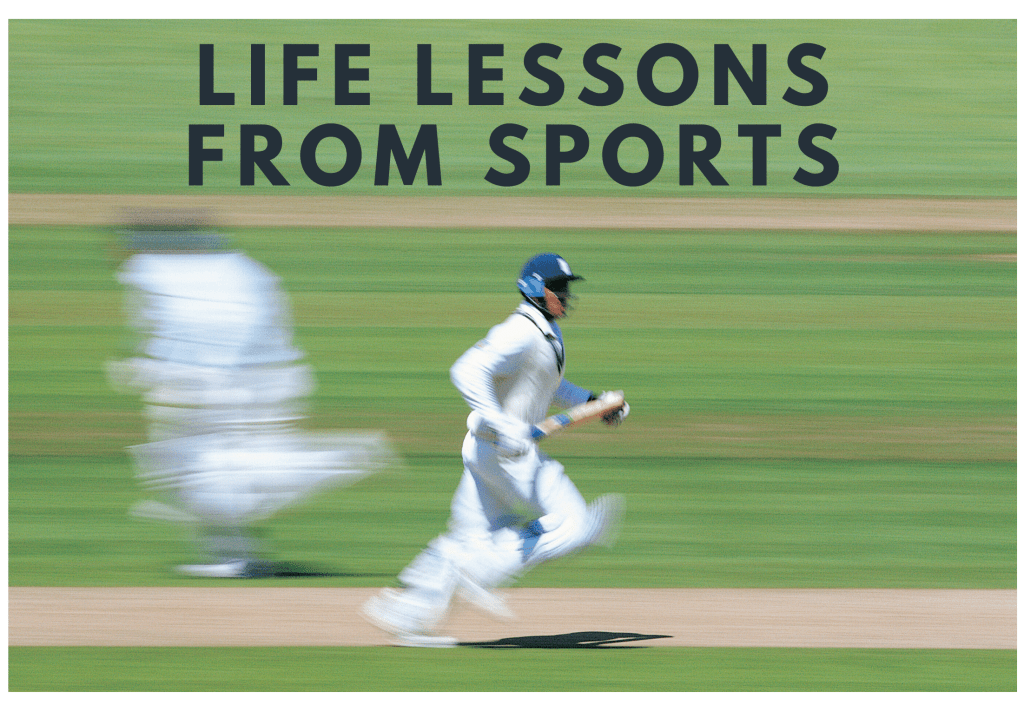
I know we all would still be in a state of shock and mourning with what we saw at the World Cup today, but as the match drew to a close and it became apparent that India is going to exit the tournament due to “45 minutes of bad cricket” (as Kohli described it later), I couldn’t help but get a bit philosophical in drawing multiple comparisons between what we saw on the cricket field today to our own professional and personal lives. So, I felt like sharing some lessons for life which may resonate with many of us in our workplace journeys.

Talented top-order’s off day

“Execution is what ultimately matters…”

India batting top-order is arguably the best in the world in terms of talent. Plus, most strategic decisions taken during the match by Kohli/Shastri made sense (except probably sending Dhoni so low down the order). And yet India failed to cross the line – Why? Poor execution. Our shot selection was poor and we just didn’t execute the right plans considering the conditions of the match. It’s the same in our profession – we can have the best talent in the organization and the best strategies in place, but without proper execution on the ground, it all counts for nothing. So what matters eventually is simply what can we get done on the ground!

Jadeja’s heroics + NZ’s death bowling

“Thriving under immense pressure…”

Imagine the kind of pressure and nerves Jadeja would be feeling when he walked in with India 6 wickets down and needing a truckload of runs to win – no one in the world would have given him a semblance of chance to achieve anything remotely close to what he actually did. And for the Kiwi bowlers when they were getting thrashed by Jadeja and facing a real threat of India overhauling the target, their bowling was calm, controlled and accurate despite the tremendous pressure! We can’t even fathom the kind of pressures sportsmen go through in crunch moments like these – in real life, the pressures may be less dramatic than on a sports field, but the message is the same – success belongs to those who not only thrive under stress, but actually get the best out of them in such nerve-wracking situations!

Guptill running out Dhoni

“Power of practice and redemption…”

Guptill had a horrible tournament with the bat. He had a nondescript day in the field…till that fateful moment when his razor sharp direct throw found MSD inches short of his crease! That run-out was probably the game changing moment that decided the winner. So how did Guptill manage to come up with such an accurate throw in split seconds under such high pressure? Practice! Modern day sportsmen hone their skills through long hours of practice and hard work, probably no different from our corporate lives, where continued dedication and focus can achieve wonders! The other aspect was how Guptill redeemed himself – all those failures with the bat forgotten with one moment of brilliance that got NZ into the finals. Such is life….it will always give us a chance to redeem ourselves and clean up our follies from the past…it’s all about how alert we are to grab such opportunities and turnaround our careers and lives with a masterstroke!

Fightbacks – NZ, then India, then NZ

“Never say die…”

This may sound clichéd, but sports is such a great teacher of the age old philosophy of never giving up in life and keep fighting till the end! NZ had lost 3 consecutive matches in the league table and barely managed to edge out Pakistan on Run Rate to qualify for the semis. They also posted only a modest score on the first day and no one gave them a serious chance. But their bowlers fought back against all odds and almost wrapped up the game in the first hour itself on the next day. But then India fought back from a bottomless pit and almost pulled out an impossible win before NZ again fought back at the end! Such an attritional game is a great display of how in life those who excel are invariably those who wear a “never say die” attitude on their sleeves!

Table toppers get a knockout punch

“Delivering when it matters…”

India topped the table winning 8 out of 9 matches. India also became the #1 ranked team recently. And yet when it mattered the most, they got knocked out in a mere 45 min…yups, one month of consistency and excellence overshadowed in 45 min of poor cricket! Sports can be cruel…and so can be life. And hence we must never count our chickens before they are hatched, and focus on delivering that knockout punch to all our challenges in life when it matters the most! What you did in the past counts for less – what you are doing as of today is what will decide how your future shapes up! Resting on past laurels is a recipe for disaster – both in sports and in the corporate world.

Kohli’s press conference

“Equanimity of a leader…”

But finally, watching Kohli’s press conference gave me a sense of calm. Now people may or may not like Kohli as a leader or captain, I am not judging that. But what struck me was the maturity with which he handled the tough volley of questions from the press. Imagine someone emotionally crestfallen after such a heartbreaking defeat, and then having to turn up immediately in front of the whole world to answer sharp critics and take ownership and responsibility for the fiasco. That’s what true leadership is all about…it’s about leading by example, owning up equally to the good and the bad, standing by your team in moments of crisis and yet doing a detailed post mortem and taking strict actions to amend the errors…but at end of the day, staying composed, self-assured, and looking at life in a broader perspective without getting too swayed by the successes and failures. Kohli said something that I hold dear as my own philosophy in life – always maintain balance as a leader – not too excited by the achievements, and not too stressed by the challenges. Equanimity of emotions and not swaying to extremes is a hallmark of a true leader.

My apologies to those who don’t follow cricket…but I hope you may still appreciate the eerie similarity sports throws up with our own lives and attitudes!
PS: For those who like reading, I had written a blog few years ago on a similar topic of how sports teaches us lessons of life…you will find it in the Archive section of this site.

Mt. Rinjani, one for the soul…

Someone asked me later if this was the toughest physical endeavour I had ever undertaken. At the end of Day 3, I had no doubt in my mind that that indeed was the case. Now a week later, with more perspective, it certainly still ranks among the top, if not THE toughest.

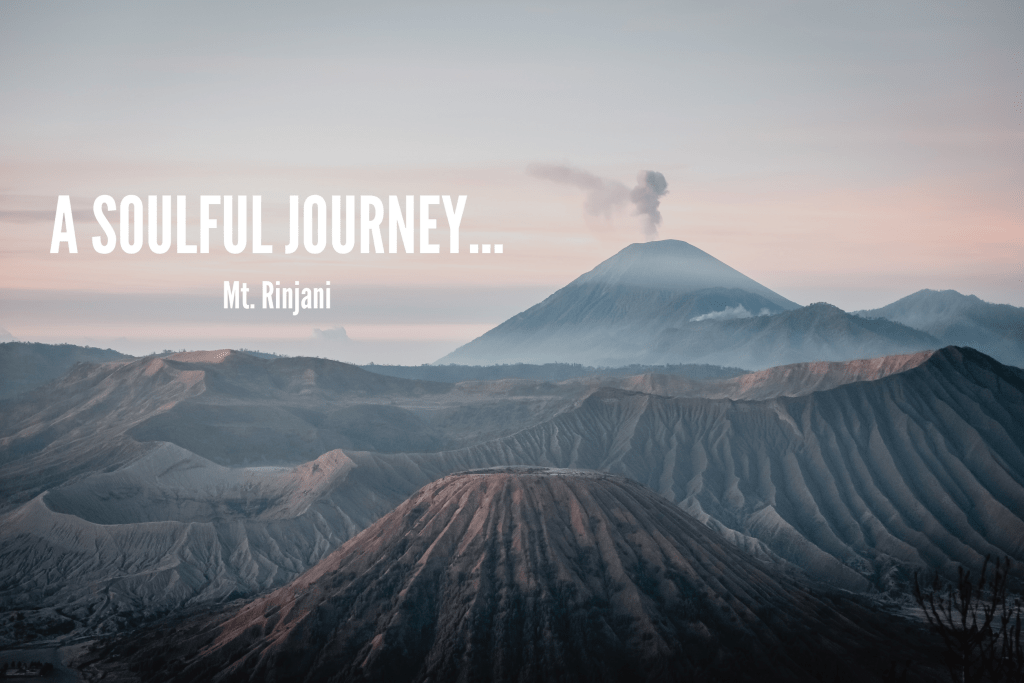
Having climbed Mt Kinabalu (13,435 ft, ranked 20th in the world by prominence) couple of years ago with relative ease, my confidence was high and spirit exuberant as we started climbing Day 1 through lush green farms baked by a scorching sun. At 12,224 ft, Mt. Rinjani, the second highest volcano in Indonesia, beckoned the 14 of us promising an adventure which our monotonous city life  rarely provides. Though, with a battery of porters carrying our camping paraphernalia, calling this a ‘climbing trek’ than a ‘mountaineering expedition’ would reflect the truth far better. Passing the first 3 rest posts after a mild 4-5 hour ascent to 5,000 ft was a warm-up now that I look back – narrow treks carved out in between farmland with a slight ascent, the heat and humidity was our only challenge. But with the holy peak visible from down below, there was no dearth of motivation to charge ahead.

The real climb really started beyond Post 3, a steep incline through a terrain interlaced with rocks leading up to the Base Camp perched at 8,700 ft. This was indeed a precursor to what lay ahead for us in this adventure. But what kept us going despite the sudden rise in exertion that accompanies the increasing altitude and dropping temperature was the breath-taking beauty around us. Literally walking through the clouds, mountains rising all around us covered with flora of varying shades of green, and the looming peak constantly watching us silently as we all made our ascent steadily was a sight that kept our heads distracted from the physical stress our bodies had started to feel. Nearly 8-9 hours after we had started, a sight of neatly laid out colourful tents in a long file perched on a mountain ledge wide enough for us to just sleep greeted our jaded bodies. The crater lake, 2000 m deep Segara Anak (child of the sea due to its blue colour), filling up the volcano caldera partially, greeted us in all its beauty, covered in parts by floating clouds changing form and shape with every passing minute. With the base camp pitched right among the clouds, the weather and visibility kept changing throughout the evening. As the sun went down, the cameras went clicking to capture the moment it hid behind the smaller peaks that stood in reverence of our mighty destination. We hoped that we would capture the sight of its next rising from the second highest points in Indonesia. With temperatures dropping fast to single digits, accentuated by the chill the wind brought with it, it wasn’t long before the group snuggled inside their tents to give their aching legs a well-deserved rest before the big day ahead.

It started at 1 am in the morning – our final ascent from base camp to the peak with lamps fixed steadily on our heads, layers of winter clothing in place, and gloves holding firm the hiking pole that was to become our lifeline. Target – to reach the peak before sunrise, a race against time, because if we didn’t, out entire day would get delayed implying another night climb before we reach the second camp later that day. It was a climb from 8,700 ft of the base camp to 12,224 ft at the peak – a journey which seemed straight forward enough in the beginning given our past climbing experiences, but which soon turned into one of the toughest expedition undertaken, turning it into a near 5 hour challenge. The first hour was probably the steepest, with every step requiring significant energy and strength in pitch dark conditions that were getting colder by the minute. The frequency of breaks to catch our breaths in an atmosphere getting rarer by the meter was rising steadily. Reaching the first flat land after the first hour was a mini achievement, giving us further boost to keep going and beat the clock. It was then that the intensity of the climb started dawning on us – the culprit? The volcanic sand that covered the journey right up to the peak! It was like walking in a desert. With every three steps we took, we slid back two, ankle deep in the black ash-like sand – and this characterised the entire climb to the peak for the next 4 hours. And that’s where I found it tougher than Mt Kinabalu, which was a climb on bare rocks – more risky with the danger of slipping, but less intense. This was a litmus test for our stamina as well as the strength of our muscles. But as the body suffered, the soul remained at peace – at that height, the silence of the mountain is only interrupted by the chilly wind whizzing past your face, gazing up you see the astounding clarity of the sky with constellations smiling down on you in all their twinkling splendour, and looking down, a file of headlamps climbing up slowly and a sheet of lights from towns far below gradually waking up to greet the sun. When you hear and feel your every breath and labour for every step you take, ironically that’s when the most peaceful your mind is. But with the peak now tantalisingly close and minutes to go for the sun to rise, I cramped on my right calf. In agony I lay down on the slope, unsure if I would be able to walk any further. But I couldn’t afford to do that, I couldn’t give up being so close. With the kind help of an accompanying friend and other climbers, I stretched, took a breather, got hydrated, and got up to beat the sun, the sand and whatever else was in between with the sheer intention of kissing the peak. And minutes later, that’s where I was. Some of our team members already there, some still behind, it was a sight that is tough to describe in words. Let’s just say that having made way through the arduous climb in toughest of terrains, the orange glow of the sun shining down on the white clouds below us, casting a shadow on the vast lake at the foot of the mountain was cathartic.

After spending few precious minutes capturing the moments on our cameras and bathing in the refreshing feeling of glory, we were forced to begin our descent in order to keep pace with the clock. The next leg of Day 2 entailed climbing all the way down to that glorious lake, breaking for lunch there along with taking a refreshing dip in the hot springs, and then climbing our way up again to the second camp at 8,100 ft. Having come down to the base camp from the peak by 8.30 am, just in time for breakfast, it wasn’t a comforting feeling to realise that the day has actually just started having already completed 8 hour of climb and descent! What lay ahead was another 6-7 hours of descent and climb over an extremely rocky terrain. When you climb down a steep descent over large boulders and rocks, on one hand it’s blissful for the lungs, but on the other it tests the joints and the toes to their limits. Knee injuries and blistered toes are common outcomes on descents through such terrains and many in the group did not escape these. But again, some of the sights as we closed in on the lake were just so extra-ordinarily surreal, that they kept us going wanting for more. These were definitely among the prettiest of sights I had ever seen, having seen a decent bit of Asia over the years now. Mist covered swathes of green on meandering terrains with the flora only partly visible by haunting clouds all around you was mystical to say the least. After another 4 hours of steep climb on high rocks where using all four limbs to climb was a common feature and walking on narrow ridges where one slip could send you tumbling into the deep valley, we finally arrived at our second camp. When they had said that this would be the toughest day physically for many of us, they clearly weren’t kidding. But the camp set on a ledge facing a glorious sunset, a bonfire lit up to provide relief to our shivering hands, a beer for some and hot tea for others – there couldn’t have been a more perfect end to the adventures of the day.

The final day’s descent back to the foothills was a cakewalk after what we had gone through earlier. A straight forward climb down through the rainforests, it was a chance for us to have hearty chats and laughs along the way as the focus had shifted from beating the clock on hazardous routes to a leisurely climb down with a relaxed mood and anticipation of a shower. Oh yes, we were a bunch without access to fresh water for three days 🙂


To say Mt Rinjhani was just an adventure would be an understatement. It was a challenge of endurance, a test of character, a treat for tired eyes, a purgation of  the soul and a chance to not only make new friends, but to get to know your own self much better. What do I take back with me?  A deep respect for those brave porters and guides who endanger their lives every day for people like us and yet wear a warm smile of contentment on their faces; a humble awe for the mountains who can silently grant you glory or wreck your life with equal ease; and a determination to begin the search for my next climb 🙂 
Everest Base Camp someday…

How sports is saving the world…one game at a time

Ok, there may be a hyperbole there. But I don’t want to lose the essence.

Saying we are living in tough times is an understatement. Depending on what lens you put on, the world can appear to be heading for the apocalypse that Hollywood predicts every other Friday. Trump fiasco has grown from election entertainment to outright panic and highlighting the obvious perils of his views would be insulting the IQ of my readers.  Once a BRIC pillar, Brazil is grappling with an unprecedented politics and economic crisis. EU’s failure in handling the Migrant mayhem is downright embarrassing and every boat going down is a blot on humanity. Brexit referendum is only going to compound its problems further. ISIS is ensuring that no human is allowed to sleep in peace. China sneezing has spread a bout of cold across global markets, such has been the over-dependence on one country to shoulder global growth. Arrogance of bottomless Saudi coffers has sent oil prices crashing and by the time the new normal sets in, hundreds of thousands of jobs would have been sacrificed. Kim Jong-Un’s nuclear rhetoric continues to shamefully hide the abysmal economic conditions in the pariah nation and keeps naval forces in the region on tenterhooks. To top it all, ice caps are accelerating to turn into water and more efforts should probably be put in to develop under-water urbanization technology than driverless cars.

Sigh!

But that’s what baffles me. I am sure every generation sees the threats its world faces as the gravest ever – and yet, somehow, we march on and there are enough statistics to show that we are actually living in much safer times. I dedicate this resilience to human spirt and that leads me to this outrageous theory that you read in my headline.

Most of us live boring lives, where the drudgery of daily survival consumes all our energy. We strive to scout for inspiration all around us so as to refuel and get ready for that next Monday. And when everyone around this planet does the same, the human spirit stands up to tackle the next challenge with the same vigour – and that’s what keeps this world rocking. Hence,  you need a unifier that gives people hope, that shows them what you read in self-help books can actually be achieved in practice, that distracts them from their stressful lives and gives them  passion and exuberance for something that has no direct relation to their personal lives – and sports is that glue that holds our race together.

How else do I explain I, an Indian, having a beer at 3 am with a Malaysian in a remote corner of Borneo watching a European and a South American country battle the ball to become the world champion in a sport where both of our respective countries suck big time?

Sports take us to a world where we believe anything is possible; where a David beats a Goliath not just in books; where rags to riches stories play out every year; where perfection, talent, dedication, fighter attitude, staunch focus, ability to hold your nerve, soaking in pressure of the highest order and ultimately, standing on top of the world are facets of life that every one of us aspires to experience, but barely anyone can.  The thrill of those extra-time minutes where a goal could change lives…the ecstasy of a win in the last over of a tight game…the serenity of the music that Barca’s tiki-taka creates…that’s the passion that draws us into a zone where our worldly worries hide behind a screen of utopia.

West Indies had no business winning that world cup final last week.  But they won not because of Brathwaite or Stokes – they won because they believed in themselves.  And why did passions run high with so many close matches in one tournament? Because that  sport is in our blood – rich or poor, smart or dumb – it binds everyone together.  

Then there is the god of tennis.  Having talent and skill is one thing – but making the most of it to rewrite all record books is another. So when a kid picks up a racket today, he tries to ape Roger and dreams of emulating that fine backhand down the line. That kid can dare to dream, and that smile on his face is thanks to what Federer has brought to the world.

And yet in the same era comes a maverick, the one that shows that even if you are not blessed with the sublime talent of the god, sheer hard work, discipline, focus, fitness and strive for perfectionism can get you to achieve the unthinkable. Djoker’s dominance in a Federer era is nothing short of a miracle – it breathes belief into the vanquished, whispering confidently that nothing is impossible.

When you are knocked down again and again by life, it is easy to vanish in the shadows of mediocrity. But a glance at the life of one Mr Agassi is enough to breathe zest into the lifeless of souls. (Please read ‘Open’ if you haven’t – I don’t think you will ever read a better autobiography than that) How to get back on your feet, conquer the demons in your mind and surpass the seemingly finite capabilities of your own body is stuff legends like him are made of.

And if it all there is doubt on what the human body and mind is capable of, we don’t need to look beyond the lightning Bolt. To hold both 100 and 200 m world records for such a long time and win 6 golds in Olympic sprints in times when fraction of seconds sift the winners from the also rans is testimony to what you can achieve if you set your mind to it.

But nothing beats what the world is witnessing this EPL season. There can be no better example of what dedication, focus, teamwork and above all, fearless belief in your own abilities can achieve. Leicester City was bottom of the table this time last year, a year where they were just promoted to be eligible to play in the league of big boys. Today, Leicester sits pretty at the top of the table and if they play like they have this season, lifting the trophy would likely be the most unbelievable triumph in recent football history. EPL is tough business, highly competitive, way tougher than other leagues where only a few dominate. In this light, one should just see how Leicester have played this season. Absolutely fearless, aggressive, a nothing to lose attitude donned on their faces, and a belief in their eyes that they can win any match. They don’t look for the trophy – they take each day as it comes and wear their passion on their sleeves, undaunted by the big names they have to face every week. What Claudio Ranieri has done with his team should be captured in the leadership lessons of business school case studies.

Leicester City story is a rebuff to the gloom in the world today – and I don’t think I exaggerate here.

The crux of the matter is that we need heroes – heroes who can inspire us to achieve what the mundane world tells us to forget. We need a Messi to show us no skills are inhuman and a Saina to remind humble beginnings are no deterrent to extraordinary achievements if you have the will. We are all needy, trapped in a bubble that we feel is impenetrable. We need to be inspired, and sports provides us the belief through its fascinating lessons for life that we can be much more than what we think we are.

Sports turns the unreal into real – and that faith is what the world needs right now.